
Federal Budget 2026 to 27 Salary Tax Slabs Amazing
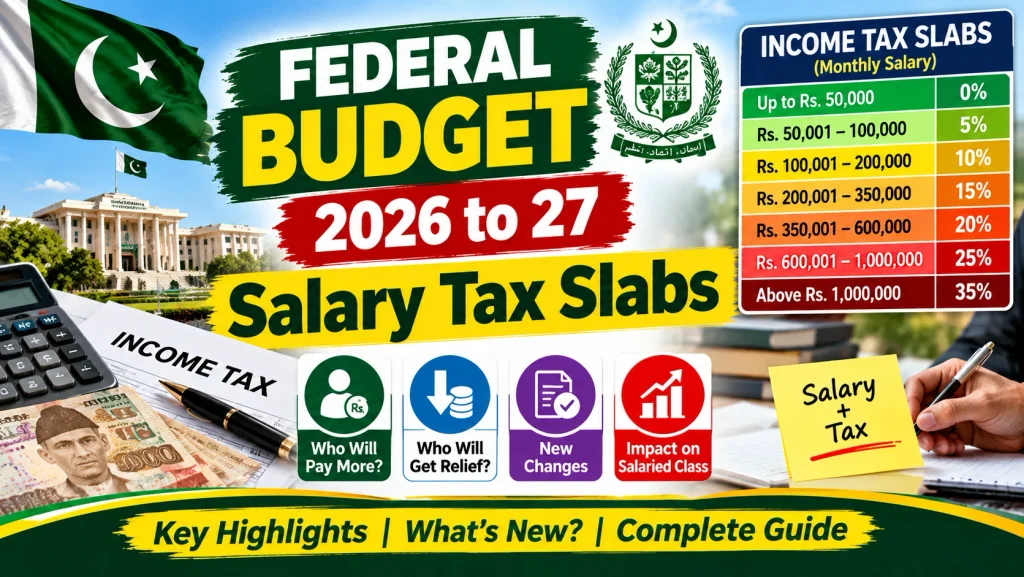
Federal Budget The federal government of Pakistan announced substantial income tax concessions for wage earners through the Finance Bill 2026 to 27 tabled before the lower house of parliament the National Assembly on June 12, 2026 by the finance minister senator Muhammad Aurangzeb. The budget with Federal Budget a total expenditure of more than Rs18 trillion was approved by President Asif Ali Zargari on June 27, 2026. It was to become applicable from July 1 2026.
The headline change is a rearrangement of salary tax slabs that lowers marginal rates across four income brackets and does Federal Budget away with the 9% surcharge that was previously applied to high Federal Budget income earning salaried individuals. Officials claim the measures bring respite to the middle and upper middle class Federal Budget but analysts highlight that those earning under Rs50,000per month Federal Budget benefited nothing as they already paid either negligible or no tax.
The bottom line for millions of salaried taxpayers is easy: what will I get to keep? This report provides a line by line analysis of Federal Budget what is currently settled the reasons cited by the government the shortcomings of the relief package and the timeline for its implementation.
Background Why the Government Restructured Salary Tax Slabs Federal Budget
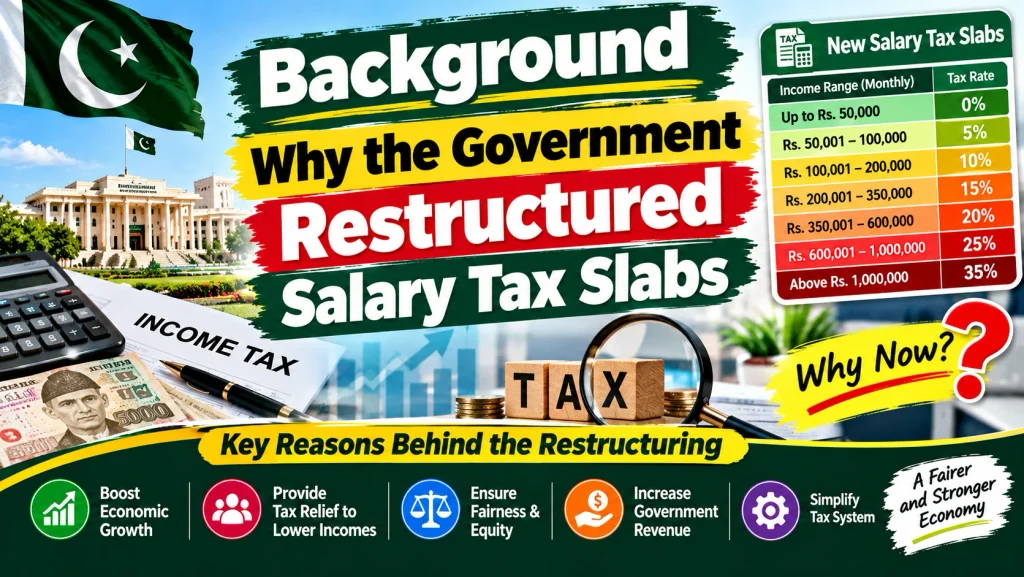
The 2026 to 27 budget published against the backdrop of ongoing cost of living pressures and a fiscal framework increasingly bled to death over the last few years is weighted toward salaried taxpayers. Federal Budget The salaried class of workers has traditionally been one of the most documented and taxed parts of Pakistan’s economy with income tax withheld at source by employers.
The earlier bracket was harsh a person earning Rs4.1m or more per year paid a marginal rate of 35 percent a charge that critics said discouraged mid career or senior workers. And those earning more than Rs10m per year paid a Federal Budget 9 percent surcharge on their total income down from 10 percent in the last fiscal year but then ultimately removed in this budget.
According to the government the objective is “to clear the tax system foster observance and ease the burden on a portion of the population Federal Budget which has been subjected to a much higher level of direct taxation”. And this relief is it adequate and does it reach those in need?
Key Figures The New Salary Tax Slabs for 2026 to 27
The following slabs apply to individuals whose income from salary exceeds 75% of their total taxable income as confirmed by multiple sources including PwC’s Pakistan tax summary and the Finance Bill text .
| Annual Taxable Salary (PKR) | Tax on Lower Limit (PKR) | Marginal Rate on Excess |
|---|---|---|
| Up to 600,000 | 0 | 0% |
| 600,001 to 1,200,000 | 0 | 1% |
| 1,200,001 to 2,200,000 | 6,000 | 11% |
| 2,200,001 to 3,200,000 | 116,000 | 20% (reduced from 23%) |
| 3,200,001 to 4,100,000 | 316,000 | 25% (reduced from 30%) |
| 4,100,001 to 5,600,000 | 541,000 | 29% (reduced from 35%) |
| 5,600,001 to 7,000,000 | 976,000 | 32% (reduced from 35%) |
| Above 7,000,000 | 1,424,000 | 35% (unchanged) |
Key changes at a glance:
- Rate cuts: Four income bands decreased rates by 3 to 6 percentage points.
- Other duties removed: The 9% duty on upper gross income above Rs10 million has been removed entirely for salaried persons while Federal Budget the tax remains on nans alarmed people and organizations of persons.
- Threshold shift: The 35% top rate now kicks in at Rs7 million compared to Rs4.1 million three steps at 29%, 32% and 35% for upper middle income earners.
- Public sector pay: Government employees saw a 7% increase in salaries, and the minimum wage increased by 10%.
Who Is Affected and Who Is Not
The trend of the distribution of relief as the table above shows is reflected in “by far the largest group of taxpayers ie the salaried in the Rs50,000 to Rs183,333 month bracket who have not received any rate reduction in the new tax Federal Budget schedule since their tax rate of 1% over Rs600,000, or Rs6,000 plus 11% on income over Rs1.2 million has not been changed”.
The beneficiaries are concentrated in higher income tiers:
- Rate goes from 23% to 20% saving an estimated Rs24K year (Rs2K month) for someone at the median Rs3.2M salary.
- Rs3.2M Rs4.1M earners Rate falls from 30% to 25%.
- Rs4.1M Rs7M earners The biggest relief rates fall from 35% to 29% or 32%.
- Above Rs10M earners The absolute savings will be the greatest with the disappearance of the 9% Marginal Add on.
- In the case of a salaried person with an Federal Budget annual income of Rs5.6m the restructuring could yield savings of up to 14.46% in tax liability compared to the prior structure .
Official Statements and Government Rationale
FM Muhammad Aurangzeb called budget a pro growth package set to be an equilibrium between relief and fiscal discipline. Federal Budget Pakistan’s economy is set to grow from $450 billion to $452 billion, the per capita income has increased from $1,751 to $1,901 foreign exchange reserves from around $4 billion three years back to a record high of $17 billion” he said in his budget speech.
In addition the government highlighted that tax relief offered to salaried persons comes as anti enforcement drives are underway to bring Rs650 billion into the tax net and are being implemented to achieve a historical Federal Budget FBR collection target of Rs15.264tr. Relief for documented taxpayers is conditional to document even more economy.
The cabinet approval for the budget Federal Budget comes hours before its presentation and the Prime Minister has already signed the budget documents at the cabinet meeting being held in Islamabad.
Comparison with Previous Years
The 2026 to 27 changes are a reversal from those earlier in the decade. In the most recent budgets rates increased for the salaried class and thresholds contracted as the government pushed up revenue collections to target Federal Budget rates with the IMF. The 35% bracket which used to start at Rs4.1 million would now start at Rs7 million another major structural change.
It’s also the surcharge. The temporary 9% charge on high earners remained a permanent tax feature and by removing it for salaried tax payers imposing it on non salaried tax payers is a conscious decision to distinguish between Federal Budget employment and business income.
However the non salaried framework is far less gentle 45% above Rs5.6m 10% on income above Rs10m. This differential may further fuel arguments about fairness in Pakistan’s tax system.
Expert and Public Reaction
Reactions have been positive. Tax experts and financial analysts have welcomed the lowering of rates and ending of the surcharge as true relief for Federal Budget higher middle and high income groups. The new intermediate brackets 29% and 32% are seen as stabilizing the upward slope leading to the top rate, so the “cliff effect” is not experienced when reaching Rs4.1 million.
Yet critics say the relief is felt by only a handful of salaried people. Comparing the analysis of Profit the bulk of salaried taxpayers are in the Rs50,000 to Rs183,333 a month income bracket and they will fail to give any such relief from the new slabs. With the dollar inflation and pump price increases eating into incomes the lower middle income lack relief.
Media commentary on social media and in op ends about whether this policy is the best approach often concerned the timing why do the highest paid receive the benefit first while those who earn the least do not? The government response that lower paid workers already pay too little tax and the increase in the minimum wage alone already helps them has not completely silenced the conversation.
What Happens Next Implementation Timeline
DATE AND IMPACT The new finance act 2026 will be in force from 1st July 2026 which signifies the beginning of the fiscal year for 2026. Employers will have to deduct withholding tax on the new slabs starting from the first pay period of the new fiscal year.
The benefits will be visible on monthly parsnip salaried persons earning between Rs2.2 million and Rs7 million should feel an impact from July 2026 while employees earning Rs10 million and above will see the surcharge line removed from their pay slips completely.
Taxpayers should refer to their employers for crosschecks of their withholding calculations and the FBR’s IRIS portal for guidance. FBR will be releasing circulars and SROs in the next few months in the notice of which implementation questions will be answered.
For More : Pakistan Budget 2026 Highlights Amazing
Frequently Asked Questions FAQs
What are the new salary tax slabs for 2026 to 27 in Pakistan?
The new structure has eight brackets: 0% up to Rs600,000; 1% on Rs600,001 to 1,200,000; 11% on Rs1,200,001 to 2,200,000; 20% on Rs2,200,001 to 3,200,000; 25% on Rs3,200,001 to 4,100,000; 29% on Rs4,100,001 to 5,600,000; 32% on Rs5,600,001 to 7,000,000; and 35% above Rs7 million .
Is the 9% surcharge on salaried income abolished?
Yes. The surcharge (Section 4AB) has been withdrawn for salaried individuals only. It continues to apply to non salaried individuals and associations of persons earning above Rs10 million .
Who benefits most from the 2026 to 27 salary tax changes?
Individuals earning between Rs4.1 million and Rs7 million annually see the largest rate cuts (from 35% to 29% or 32%). Those earning above Rs10 million benefit most in absolute terms from the surcharge abolition .
Do low income salaried workers get any relief?
Those earning below Rs50,000 per month already pay no tax. Individuals in the Rs50,000–Rs183,333 monthly range saw no rate reduction; their tax liability remains unchanged .
When do the new tax slabs take effect?
The changes apply from July 1, 2026, the start of fiscal year 2026-27, following the President’s approval of the Finance Bill on June 27, 2026 .
Are non salaried taxpayers affected by these changes?
No. The slab reductions and surcharge abolition apply only to salaried individuals. Non-salaried rates remain at up to 45% with a 10% surcharge above Rs10 million .
How can I verify my new tax deduction?
Check with your employer’s payroll department for the updated withholding calculation. You can also consult the FBR’s official IRIS portal or a qualified tax consultant for clarification .
Conclusion
The 2026 to 27 salary tax slab overhaul offers real relief to middle and upper middle class taxpayers with tax rate cuts of up to 6 percentage points and the removal of a surcharge imposed on top earners for years. For a salaried worker in the Rs4.1 million to Rs7 million income category the tax benefit is sizeable for anyone earning over Rs10 million getting rid of the surcharge is a bonanza.
But the package does nothing to benefit the largest section of the salaried taxpayers (earning Rs50,000 Rs183,333 a month). The question of whether the government’s larger economic agenda including the 10 per cent minimum wage hike will take care of the rest remains to be seen during the coming fiscal.
Follow for updates More clarifications may arise as the FBR circulates implementation notifications and employers modify payroll registers. Save this page and check the FBR’s website regularly.
Disclaimer: All figures and date provided in this report are taken from budget figures announced officially and the data reported in the press till time of publication. The tax laws also have a tendency to be changed via SROs or circulars and subsequently via new law enacted. The reader should cross check the same from FBR or a tax adviser before making such financial commitment. This article has no connection with Government of Pakistan.



One Comment