Inflation Rate Pakistan 2026
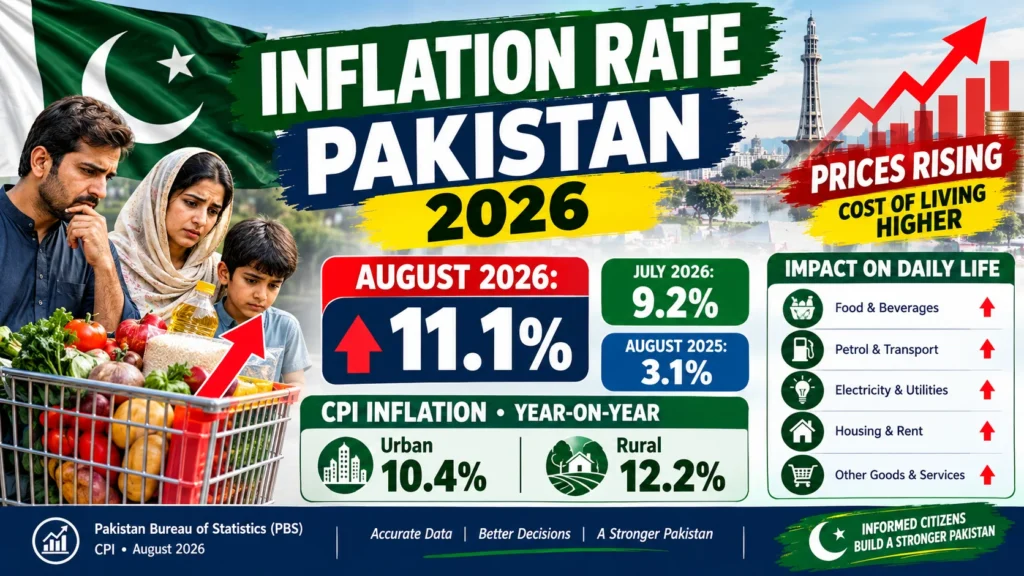
Inflation Rate Pakistan Pakistan’s annual consumer price inflation zoomed up to 11.1 percent in August 2026 and made back to double digits briefly snatched back in July according to data released by the Pakistan Bureau of Statistics (PBS). A leap from July 2026’s inflation rate at 9.2 percent, the increase has mostly been driven by sharp spikes in food and fuel prices.
Consumers are taking the rise of a 1.2 to a 11.1 percent blast as the price slump back in July had brought them hope for some relief from the escalating living crisis as it was the first single-digit number since March but the current statistics suggest otherwise. Pakistan Bureau of Statistics’ (PBS) August report represents the converging impacts of political turmoil across Middle East, natural adversities due to monsoon showers disrupting supplies and increased global crude oil prices continuing to strain its domestic economy.
Month-on-month CPI remained static with 1.2 pc against July and that of rural at 12.2 % against urban 10.4% illustrating rural population being hit harder than urban areas, while its month-on-month increase held the steady percentage, just like month-on-month inflation from April this year.
Background and Context Inflation Rate Pakistan
Pakistan’s inflation trend in 2026 has been extremely unstable. From Pakistan Economic Survey 2025 to 26 (presented by Finance Minister Muhammad Aurangzeb in June) an average CPI inflation rate of 6.2% was noted in July April FY2026 as against 4.7% in the like period of previous fiscal year.
However, this has also shown an alarming inflation hike from 7.3% to 10.9% in March to April as the consequence of the unfolding conflict situation in the Middle East took toll. Inflation Rate Pakistan Pakistan faced double-digit monthly inflation in April, May and June with inflation rate at 10.9%, 11.7%, 11.1% respectively and then in July there has been a relative easing down to 9.2% as stated.
Government attributes the current inflationary trend to exogenous shocks-increasing US-Iran conflict and its spillover impact to global oil prices, which make Pakistan, an oil importing country, very vulnerable.
Key Details and Figures Announced Inflation Rate Pakistan
The Pakistan Bureau of Statistics released the following key inflation figures for August 2026:
| Indicator | August 2026 | July 2026 | Change |
|---|---|---|---|
| Headline CPI (Year-on-Year) | 11.1% | 9.2% | +1.9 pp |
| Urban CPI | 10.4% | 8.7% | +1.7 pp |
| Rural CPI | 12.2% | 9.9% | +2.3 pp |
| SPI (Sensitive Price Indicator) | 10.72% | 12.0% | -1.28 pp |
| WPI (Wholesale Price Index) | 10.62% | 9.4% | +1.22 pp |
Source: Pakistan Bureau of Statistics
Sector-Wise Inflation Breakdown
| Category | Year-on-Year Increase |
|---|---|
| Food and Non-Alcoholic Beverages | 13.89% |
| Housing, Water, Electricity, Gas, Fuel | 8.87% |
| Clothing and Footwear | 9.23% |
| Health Costs | 8.02% |
| Education Charges | 7.82% |
| Restaurants and Hotels | 6.1% |
| Furnishing and Household Equipment | 7.08% |
Source: Pakistan Bureau of Statistics
Food Price Trends Inflation Rate Pakistan
| Commodity | Price Change |
|---|---|
| Tomatoes | +174.74% |
| Onions | +75.86% |
| Wheat | +77.71% |
| Wheat Flour | +67.56% |
| Liquefied Hydrocarbons | +46.43% |
| Motor Fuel | +16.04% |
| Potatoes | -34.36% |
| Sugar | -20.96% |
| Chicken | -13.49% |
Source: Pakistan Bureau of Statistics
Who Is Affected and How
Rural Communities Inflation Rate Pakistan
The rural inflation at 12.2 per cent, is far higher than the urban inflation; thus the maximum pressure falls on to the already facing input costs for agricultural villages . Inflation Rate Pakistan The inflation on food for rural area has spiraled up significantly, rural food inflation has risen to 4.7 percent during July-April FY2026 compared to inflation of 1.5 percent during same period in FY2025 (survey reports)
Low Income Households
The SPI which measures prices of commodities essential to poorer segments of society has reflected quite disturbing trend. Although August shows (10.72 percent) a marginal deceleration in SPI inflation rate in August in the Inflation Rate Pakistan comparison of July (12.04 percent), yet, the lowest consumption strata continue to bounder pressure and weekly SPI for poor households decreased by 0.17 percent in the last few days of August showing some ease.
Urban Middle Class Inflation Rate Pakistan
At the household level in urban areas, prices are increasing in many diverse expenditure categories. Communication fees for June increased by 19.30 per cent compared with May and motor vehicle tax increased by 38.68 per cent.
Transport and Logistics Sector
The rise in fuel price has heavily impact the transport Inflation Rate Pakistan sector. At late August 2005 prices petrol increase 29.84% year-on-year and diesel price increase 36.33% year-on-year brokerage house estimates transport index inflation to be 19.6% yoyo in August, largely fueled by houses in motor spirit and diesel prices Inflation Rate Pakistan
Official Statements Inflation Rate Pakistan
Finance Minister Muhammad Aurangzeb
Introducing the Pakistan Economic Survey 2025 to 26 to the press in June, the minister for Finance Muhammad Aurangzeb claimed inflation on the fiscal year continued to be broadly under control owing to appropriate macro-economic policies and favorable supply conditions-withstanding the potential shock Inflation Rate Pakistan from external side of balance of payments as inflation sources–according to survey showing inflation averaged 6.2% over July to April FY2026.
Pakistan Bureau of Statistics (PBS)
The PBS reported that inflation for the year on year September rate fell to 9.2 percent from 11.1 percent in the June report Inflation Rate Pakistan and said this was due to falling food and energy prices . But this proved short lived as inflation rose again in August .
Finance Division Inflation Rate Pakistan
In July’s Economic Update and Outlook the Finance Division forecast CPI to fall between the levels of 9.0 to 10.0 per cent during July due to increases in the world oil price and its possible pass through effects to domestic electricity prices and transportation prices 9 . Inflation Rate Pakistan This level was met with an actual value for July of 9.2 per cent.
Comparison with Previous Periods Inflation Rate Pakistan
| Period | CPI Inflation Rate |
|---|---|
| August 2026 | 11.1% |
| July 2026 | 9.2% |
| June 2026 | 11.1% |
| May 2026 | 11.7% |
| April 2026 | 10.9% |
| March 2026 | 7.3% |
| Average FY2026 (July-April) | 6.2% |
Sources: Pakistan Bureau of Statistics
Expert and Public Reaction
Brokerage Projections Inflation Rate Pakistan
According to AKD Research, the expected headlines for the month would be 11.4 pc y o y while Topline Securities forecasted range at 10.75 pc to 11.25 pc for August’s inflation. The realized inflation was in the analyst’s forecasts.
The factors attributed to were: Food Index (14.8 per cent y o y, onion prices up 59.5 pc m-o-m, Transport Index (19.6 per cent y o y and the Inflation Rate Pakistan transportation driven by an increase in the price of motor fuel, Wheat Flour (6.3 per cent m-o-m post the government efforts on building strategic reserves.)
Public Response
Consumers appear highly anxious about the recent return of double-digit inflation. Social media platforms have been inundated with complaints of increasing food and energy prices, driven by steep increases in the price of wheat flour, onions and tomatoes Tomatoes saw price of 116.75% over month, onions for 20.15%, and wheat flour for 67.56% over the past year respectively.
Expert Analysis
The economic fallout of the Middle East crisis also seems to be felt in the Pakistan. Supply chain disruptions both due to the monsoon and the transporters strike have fueled inflation especially concerning foods. Increased food prices may also be due to the government’s policy of passing on the increased global rates of petroleum to the local consumers under the daily pricing mechanism regime.
What Happens Next / Implementation Timeline
Near Term Outlook
“While inflation should not remain excessively high on a sustained basis, recent sources of upward price pressure may continue to translate through to the domestic economy over the next couple of years through a number of mechanisms; such as through their effects on global commodity and energy prices, stated a report from the PBS. By August 2006, CPI inflation was expected to persist between 10 to 11%.
Government Measures
Although the government may maintain close watch on global oil prices and accordingly revise fuel prices domestically as part of daily pricing mechanism. Analysts observe that the level of flexibility to control prices under daily oil price regime has narrowed considerably given the fiscal deficit and the IMF program:
Monetary Policy Implications
Analysts predict that an actual declining real interest rate to 25 to 75 basis points-significantly lower than its historically average of 200-300 basis points-may apply upward pressure on the State Bank of Pakistan to keep or further increase its interest rate.
For More :
Frequently Asked Questions (FAQs)
What is the current inflation rate in Pakistan?
Why did inflation increase in August 2026?
How does rural inflation compare to urban inflation?
What is the Sensitive Price Indicator (SPI) inflation?
How much have food prices increased?
When will the next inflation data be released?
Conclusion
Return to double-digit inflation for Pakistan in August, at 11.1 per cent, underscores ongoing vulnerability in the economy. A single digit print of 9.2 per cent in July had briefly lifted the sentiment before resurgent food and fuel price increases aggravated the pressures facing families at the cash till across the country.
Rural folk endure greater inflation than urbanites at 12.2 per cent compared with urban 10.4 per cent which increases the strain further. Wheat flour is up 67.56 per cent while onions’ prices are higher at 75.86 per cent and tomatoes’ at 174.74 per cent than 12 months prior forcing families to tighten the screws and decide where to pull back for basic survival and requirements.
Balancing continued fiscal discipline in compliance with the IMF package against need for subsidizing the essentials will remain a core aspect in economic policy formulation henceforth as July April average inflation from the 2025 to 26 Economic Survey came out at 6.2 per cent though present trends may drive FY ending inflation higher than earlier projected.
The response of the State Bank of Pakistan monetary policy interest rate increases are largely expected will determine direction that the inflationary trend settles at hereafter. Survival demands prudent cash flow management for consumers and entrepreneurs.
Further data from Pakistan Bureau of Statistics will add more perspectives on the issue while the relevant government agency, for example its ministries or divisions, can develop a policy response aimed at curbing inflation to restore price stability.
Disclaimer: This article is written based on the information as per September 2026. Economic indicators are subjected to change. Readers should obtain a confirmation of these statistics by referring to latest data available from authentic sources such as the Pakistan Bureau of Statistics (pbs.gov.pk) and Finance Division before taking any financial decisions.