Pakistan Government Policy Update Ultimate Amazing 2026
Pakistan Government Policy Update ISLAMABAD The PM Shahbaz Sharif has given his in-principle approval to Pakistan’s new auto policy 2026 to 31 and it will establish long-awaited changes. It has decided in a high level meeting chaired by the premier to consider and improve on the policy, under which efforts are focused to make surroundings amenable to investments in the country’s automotive sector and stimulate Pakistan Government Policy Update motor vehicle exports while also incentivizing the use of modern technology.
The government intends to provide draft of policy to IMF and if approved will subsequently move it to ECC to be brought to the Parliament, as it will be laid before federal cabinet. As parallel it has been decided by the ECO meeting led by Finance Minister that Pakistan Government Policy Update six hundred and sixty million dollars will be spent on acquiring thirty armored cars for the oncoming SCO summit to be hosted by the Pakistani in September 2027.
Auto Policy 2026 to 31 Key Features and Incentives Pakistan Government Policy
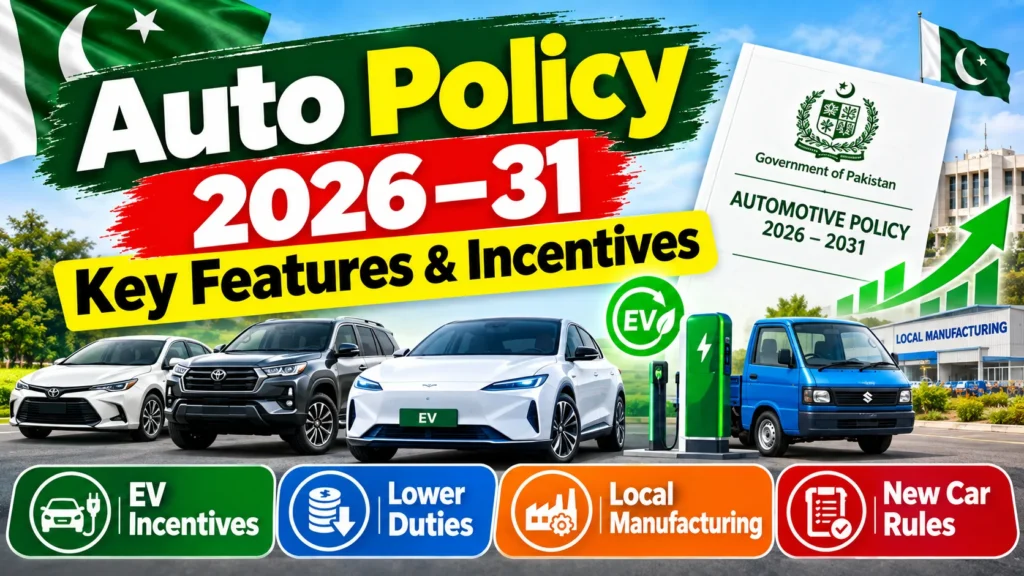
The new automotive policy of the country is a bold policy step aiming to redesign Pakistan’s automotive landscape. Pakistan Government Policy Update The policy features a bundle of incentives geared toward promoting adoption of hybrid cars; boosting local manufacturing and attracting foreign investment
Tax Reductions for Hybrid Vehicles Pakistan Government Policy
| Vehicle Category | Current Duty | Proposed Duty | Timeline |
|---|---|---|---|
| Hybrid vehicles up to 800cc | 50% | 30% | Over 5 years |
| Hybrid vehicles 851cc-1,000cc | 50% | 30% | Over 5 years |
| Hybrid vehicles 1,501cc-1,800cc | 50% | 30% | Over 5 years |
| Hybrid vehicles above 1,801cc | 50% | 30% | Over 5 years |
| Hybrid trucks | 30% | 15% | Over 5 years |
| Hybrid commercial vehicles | 60% | 30% | Over 5 years |
| Hybrid buses | 30% | 15% | Over 5 years |
The draft policy also proposes a 20% reduction in taxes on hybrid vehicle imports over the next five years .
Environmental Levy on Larger Vehicles Pakistan Government Policy
To meet revenue needs and support green transportation an environmental levy is also being explored with respect to larger vehicles
10% environmental levy on vehicles with engine capacity from 2,001cc to 3,000cc
19.5% environmental levy on vehicles with engine capacity > 3,001cc
Over the next 5 years total revenue Pakistan Government Policy Update from the proposed environmental levy is expected to be Rs142.79 billion which would be applied to promoting exports and research and development .
Policy Objectives Pakistan Government Policy
The primary goals of the proposed auto policy include
Enhancing investment conditions in the country’s car manufacturing sector
Increasing the export and domestic production of vehicles
Introducing advanced technology and R&D
Making hybrid vehicles cheaper in the domestic market
ECC Approves Rs6.6 Billion for SCO Summit Vehicles
The Economic Coordination Committee (ECC) sanctioned a Pakistan Government Policy Update Technical Supplementary Grant (TSG) amounting to Rs6.6 billion for procurement of 30 bullet proof vehicles that were required for the movement of Heads of State during SCO Summit.
Background
The Cabinet Division had asked for the acquisition of the Pakistan Government Policy Update bullet proof vehicle; on the ECC it was confirmed that Rs. 12.6 billion was needed for such a task. The ECC then agreed on Rs. 6.6 billion; which was enough for the purchase of 30 vehicle and the ECC advised the Cabinet Division to thoroughly Pakistan Government Policy Update analyze the requirement before further proposal for the purchase of bullet proof vehicle.
It will be important that Pakistan receives an in depth analysis for further needs from the Cabinet Division after all the SCC summit would be hosted by Pakistan on September 2027.
Other ECC Decisions
The ECC meeting, chaired by Finance Minister Senator Muhammad Aurangzeb, also took several other important decisions
| Decision | Details |
|---|---|
| Tobacco Crop MIPs | Deferred; Ministry directed to resubmit with justifiable analysis |
| Donkey Meat Export | Approved with safeguards from Gwadar Free Zone |
| Gas Supply to FatimaFert & Agritech | Extended till September 30, 2026 |
| Daanish Schools Authority Fund | Rs5 billion seed money approved |
| Pakistan Skills Impact Bond | September 30, 2026 deadline for progress report |
Refinery Upgrade Policy Penalties for Missing Deadline
In the event of failure to execute the upgradation Pakistan Government Policy Update contracts with the Petroleum Division until October 1 2026 financial penalty would be imposed by the Federal Government on oil refineries.
Key Policy Changes
The federal cabinet approved the changes to the Pakistan Oil Refining Policy for the upgradation of existing brownfield refineries (2023) that was forwarded by the cabinet committee on energy.
| Aspect | Previous Framework | Revised Framework |
|---|---|---|
| Agreement Signing Authority | OGRA | Petroleum Division |
| Signing Period | 60 days | 45 days |
| Policy Monitoring | OGRA | Petroleum Division |
| Incentive Deposit | Escrow accounts with OGRA | Refinery Upgradation Account |
Penalties for Non Compliance
Those refineries that are unable to sign upgradation agreements by the 1st of October shall deposit deemed duty above 5% on High Speed Pakistan Government Policy Update Diesel (HSD) into the refinery upgradation account by June 30 2027 .
Those that sign upgradation agreement by 1st October will see the assumed duty on HSD go from 2.5% in 2024 and 0% by November 15, 2026 .
Expected Benefits
Information given to the Cabinet by the Petroleum Division. The enhanced can
Save approximately $1bn in foreign exchange per year
Attract $6bn in investment to Pakistan’s refining industry
Produce Euro V compliant diesel and petrol
Saudi Arabia also keen to invest in Pakistan’s refinery industry .
Export Led Growth: Enhanced Financing Support
Significant steps have been introduced by the Government to ease Pakistani exporters through improved access to concessional short & long term export finance.
Enhanced Export Finance Scheme (EFS)
| Parameter | Previous | Enhanced |
|---|---|---|
| EFS Envelope | PKR 1,000 billion | PKR 1,500 billion |
| SME Exporters Allocation | – | PKR 300 billion |
This additional provision is supposed to create improved financing opportunity in the entire export domain especially for SMEs newcomers and newly arriving exporters.
Long Term Export Growth Financing Facility
LTEDGFF has been launched by the Government of Pakistan with financing lines of PKR 350 billion for establishing the machinery to Pakistan Government Policy Update encourage long term investment and export capacity of the industry. This facility will enable exporters to:
Purchase and installation of new plant machinery
BMR (Balancing, Modernization and Replacement) on old projects
Promote and boost investment for transition of Pakistan to green economy.
Access to Finance Progress Across Priority Sectors
Finance Minister Senator Muhammad Aurangzeb, chaired the fourth Access to Finance Steering Committee meeting in which the performance Pakistan Government Policy Update progress was discussed. This included reforms to promote cost effective and inclusive finance in priority sectors.
Key Progress Updates
| Sector | Achievement | Target |
|---|---|---|
| SME Financing | PKR 1.067 trillion (323,987 borrowers) | PKR 2 trillion by June 2028 |
| Agriculture Finance | PKR 1.268 trillion (3,392,092 borrowers) | PKR 2 trillion by June 2028 |
| Housing Finance (Apna Ghar) | Rs351.3 billion approved (60,349 loans) | – |
| Electric Vehicles (PAVE) | 17,118 approved applications | 1,860 e-bikes delivered |
Zarkhez e Asaan Zarai Garza Programme
It was informed of the advancements relating to the Arches programmed, a facility designed to give collateral free loans to farmers.
Number of beneficiaries enrolled is 58,919. Number of applications received is 35,838. Number of loan approved was 16,964 for Rs 7.349 billion. Number of loans of value Rs 1.956 billion disbursed was 5,174.
Asaan Trader Scheme Bringing Traders into the Formal Economy
The government’s “Asaan Trader Scheme” offers an avenue to the smaller trader & shopkeeper to enter the formal economic sphere of registration.
Key Features
For Whom: Traded with an annual turn-over of more thanRs20 crore and less than Rs1 crore.
Minimum Annual tax: Rs 25,000
Other Benefits: exemption from audit Amnesty for registered traders
Registration deadline September 30, 2016
According to Yasmin Fatima Chief Commissioner Regional Tax Office Islamabad this scheme is friendly positive and helpful move for Pakistan Government Policy Update business community so that the culture of fear and alienation between tax evader and tax authority will change to co operation facilitation and trust on each other
Who Is Affected and How
Automobile Sector
Direct influence will be: Consumers (lower hybrid costs),Manufacturers (local production incentives), and Importers Pakistan Government Policy Update (lower hybrid import duties coupled with emission charges on larger models) with respect to Auto Policy 2026 to 31.
Oil Refining Sector
The refineries who cannot sign the upgrading agreements by 1st October 2026 will be required to deposit as Deemed duty and Pakistan Government Policy Update license for non upgrading will be threatened with removal along with cessation of benefits until rectification
Exporters and SMEs
Impacts of improved export finance will be felt on:
• SME Exporters (Specific support to tune of Rs300 billion)
• New Borrowers (Access to export finance)
• Agre SME (agricultural export)
Small Traders
The advantages of the Asian Trader Scheme include
Easy tax registration
Tax exemption, meaning you will not be audited, and
Green plates with QR codes for shops that registered
Official Statements
Prime Minister Shehbaz Sharif
At a meeting with major industrialists and businessmen, the Prime Minister stated that if growth was there it had to be export led Pakistan Government Policy Update otherwise growth had no meaning . He claimed that there had been recovery of Rs 800 billion in one year through enforcement measures only, without any new taxes.
The Prime Minister pointed out that during the last 2 and a half years, the government introduced all the long due structural reforms with consistent effort through team work between government and private sector.
Finance Minister Senator Muhammad Aurangzeb
According to Finance Minister, the Steering Committee deliberations need to remain oriented toward concrete outcomes, Pakistan Government Policy Update focused on core issues and progressively shift the emphasis onto execution. Major proposals to the Steering Committee were to initially be discussed in the relevant sub committees.
Petroleum Division
Petroleum Division assured the Cabinet that through improvement in refineries. Around $1 billion of annual Forex saving and investment inflow in refinery sector is expected.
Comparison with Previous Policy
The Auto Policy 2026 to 31 represents a significant departure from previous policies:
| Aspect | Previous Policy | New Policy (2026 to 31) |
|---|---|---|
| Hybrid Vehicle Duties | 50% (various categories) | Phased reduction to 30% |
| Environmental Levy | Not applicable | 10 to 19.5% on larger vehicles |
| Policy Duration | 5 years | 5 years (2026 to 31) |
| Focus | Traditional vehicles | Hybrid and modern technology |
This can already be noticed from the June Budget 2026 to 27 that the government was focusing more on the transition of stabilization Pakistan Government Policy Update and sustained development through export led growth and making the business climate amenable 3.
What Happens Next / Implementation Timeline
Auto Policy 2026 to 31
- IM F review. Policy to be shared with I M F for endorsement.
- E C C presentation. Once I M F endorse policy.
- Federal Cabinet. Necessary for policy.
- Parliament presentation for announcement.
Refinery Upgrade Deadline
- 1 October 2026 Refineries to enter into the upgradation contract agreement.
- 15 November 2026 Deemed duty for HSD for compliant refineries to be waived off (become zero)
- 30 June 2027 Deemed duty to be paid by the non compliant refineries for HSD to be payable
Asaan Trader Scheme
For More : HEC Scholarships 2026 Apply Online Ultimate Amazing
Frequently Asked Questions (FAQs)
What is the new Auto Policy 2026 to 31?
How will the new auto policy affect hybrid vehicle prices?
What is the environmental levy on larger vehicles?
What is the refinery upgrade deadline?
What is the Enhanced Export Finance Scheme?
What is the Asaan Trader Scheme?
Conclusion
This week’s policies are aimed at boosting economic reform, export and increasing interventions in sector specifics. Auto Policy 2026 to 31 introduces Pakistan Government Policy Update hybridization and Localization of Auto Sector for exports whereas the Refinery upgradation policy will upgrade Pakistan’s Refinery infrastructure, conserve foreign exchange resources. Expanded export financing schemes and SME Access to Finance Policy Agriculture and Housing sectors access to finance show the government’s aim to increase participation Pakistan Government Policy Update in the economy through inclusive policies. Mean while Asian Trader Pakistan Government Policy Update Scheme provides small businesses a path to join formal economy of Pakistan.
[button linking to our website] Visit https://www.policywatch.pk/ for further details on the recently unveiled policies or sign up to our news letter to remain updated on the policy sector of Pakistan!
Auto Policy 2026 to 31 still awaits IMF approval, Economic Coordination Committee (ECC) and Cabinet Approval. October 1 deadline Pakistan Government Policy Update issued to upgrade refinery agreements. Export Finance Scheme expanded by PKR 1,500 billion Registration for Asian Trader scheme deadline: September 30, 2026following official government announcements and reputable news sources.
Disclaimer: The data reported in this article is as of 10th September 2006. Policy details are subject to formal approvals. Official source(s) for updated Pakistan Government Policy Update policy information can include the Ministry of Finance, ECC and the concerned government department(s).